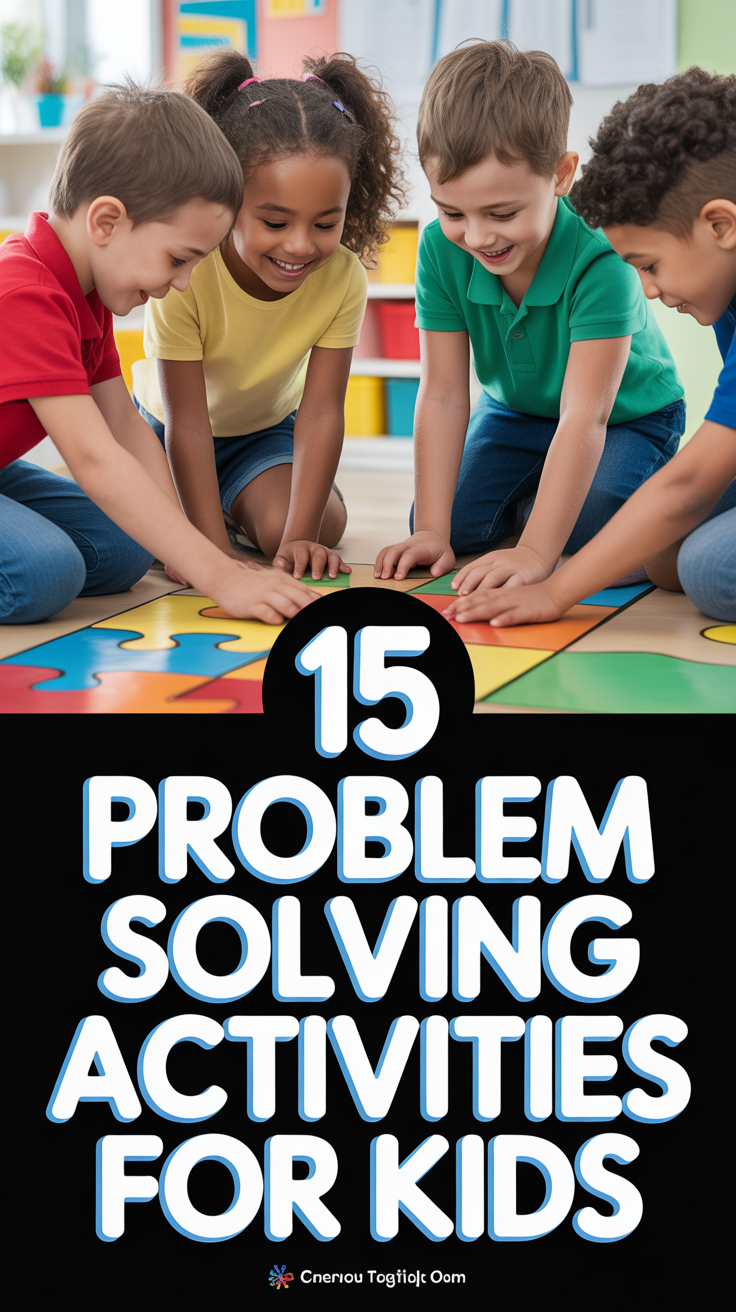
🧠 15 Problem Solving Activities For Kids
Okay, so we all know the drill. You blink, and suddenly your tiny human is demanding screen time like it’s their lifeblood. We get it, the digital babysitter is tempting. But before you hand over the tablet for another round of whatever game involves tapping relentlessly, let’s talk about something way cooler: turning your little mini-me into a pint-sized problem-solving guru. Because, honestly, life’s just one big puzzle, right? And who doesn’t want their kid to be the one who figures out how to get the last cookie from the top shelf?
We’re not talking about boring worksheets here. Nope. We’re diving into activities so fun, your kids won’t even realize they’re flexing those critical thinking muscles. Prepare for less “Mom, I’m bored” and more “Aha, I got it!” (Hopefully, anyway. No promises on the volume levels).
1. The Mighty LEGO Challenge
Forget just building the pre-designed spaceship. Give them a pile of bricks and a mission: build a bridge strong enough for their heaviest toy, or a house that can withstand a “windstorm” (aka, your breath). This isn’t just about stacking; it’s about engineering on the fly.
Pro tip: Introduce a limited number of specific pieces. Constraints breed creativity, darling. They’ll have to strategize which piece goes where to make their vision a reality. It’s like tiny architecture school, but with fewer existential crises.
2. Jigsaw Puzzles with a Twist
Classic, yes, but evergreen for a reason. Jigsaw puzzles teach spatial reasoning, pattern recognition, and the sweet satisfaction of seeing things click into place. But let’s spice it up.
Try doing a puzzle backwards (starting with the edge pieces, then working inwards, but focusing on the image rather than the shape of the piece). Or mix two similar puzzles together for an epic sorting challenge. It’s like a brain workout, but way more colorful.
3. Board Game Bonanza
Step away from Candy Land for a minute (unless that’s your jam, no judgment). Games like Ticket to Ride: First Journey, Spot It!, or even simple checkers teach strategy, foresight, and gracious losing (a lifelong skill, trust us).
Pro tip: Play with them and narrate your thought process. “Hmm, if I move here, what might you do next?” It shows them how to think a few moves ahead. Winning isn’t everything, but learning how to win (or at least play smart) definitely is.
4. The Epic Scavenger Hunt
Hide clues around the house or yard that lead to a “treasure” (a new book, a small toy, or even just a healthy snack). Each clue should be a mini-riddle or a simple direction.
This activity hones observational skills, logic, and following instructions. Plus, it burns off some serious energy. They’ll feel like Indiana Jones, minus the snakes.
5. Kitchen Concoctions
Let them help bake or cook. Following a recipe requires reading comprehension, measurement skills (hello, fractions!), and understanding cause and effect. What happens if you forget the baking soda? Chaos, that’s what.
Pro tip: Give them a simple recipe and let them lead. You’re merely the sous chef. They’ll learn that precise steps lead to delicious outcomes, or at least edible ones.
6. DIY Obstacle Course
Use pillows, blankets, furniture, and anything else you can find to create an indoor or outdoor obstacle course. The challenge is to navigate it without touching certain “lava” spots or using only specific body parts.
They’re not just climbing; they’re figuring out the most efficient (and safest) path. It’s like parkour, but with significantly less risk of broken bones.
7. The Great “What If” Game
“What if we woke up and all the colors disappeared?” “What if animals could talk?” Pose open-ended questions and let their imaginations run wild with solutions and consequences.
This encourages creative thinking, empathy, and understanding different perspectives. It’s a low-prep way to spark some seriously deep (and hilarious) conversations.
8. Simple Science Experiments
Think baking soda volcanoes, making slime, or building a homemade catapult. These activities introduce basic scientific principles and require kids to follow steps, observe, and troubleshoot when things don’t go as planned.
Pro tip: Let them hypothesize what will happen before you start. And when it inevitably goes wrong (because science!), ask them why they think it didn’t work and what they could change. Failure is just a data point, right?
9. Coding for Kiddos
There are tons of apps and online games (like Scratch Jr. or Code.org) that introduce basic coding concepts through fun, visual puzzles. They learn sequential thinking, logic, and debugging.
It’s like teaching them a secret language for telling computers what to do. And let’s be real, in this tech-heavy world, that’s a superpower.
10. Riddles and Brain Teasers
“What has an eye, but cannot see?” (A needle, obviously). Simple riddles and brain teasers are fantastic for lateral thinking and wordplay. Keep a book of them handy for car rides or dinner table entertainment.
They’re like mini mental workouts that don’t even feel like work. Plus, who doesn’t love feeling clever?
11. Nature Exploration Challenges
Head outdoors with a specific mission: find 10 different types of leaves, or build a tiny fairy house using only natural materials found on the ground.
This encourages observation, classification, and creative construction with limited resources. It’s like a scavenger hunt, but with more dirt and fewer instructions.
12. Storytelling with Prompts
Give them a few random objects (a rubber duck, a button, a key) or a crazy sentence starter (“Once upon a time, a dinosaur rode a skateboard…”) and challenge them to weave a story.
They’re connecting disparate ideas, developing plot, and thinking on their feet. Bonus points if they act it out.
13. The Budgeting “Trip”
Give your child a pretend budget (e.g., $100) and a destination. Have them plan out how they’d spend it on transportation, food, and activities. They can look up real prices online.
This teaches practical math, decision-making, and understanding priorities. They’ll quickly learn that a fancy hotel means less money for ice cream. The tough choices begin early!
14. Building with Recyclables
Collect cardboard boxes, toilet paper rolls, plastic bottles, and other recyclables. Challenge them to build a robot, a castle, or a car using only these materials and tape/glue.
This promotes resourcefulness, spatial reasoning, and creative problem-solving. It’s amazing what a little junk can become with a big imagination.
15. Tangram Puzzles
These ancient Chinese puzzles involve arranging seven flat shapes (tans) to form specific designs without overlapping. You can buy sets or print templates online.
They’re fantastic for spatial awareness, geometric understanding, and persistence. It’s like Tetris, but in real life and way more satisfying when you nail it.
Conclusion
See? Who needs a screen when you’ve got a whole world of brain-boosting fun right at your fingertips (or, you know, around the house)? These activities aren’t just about keeping them busy; they’re about equipping your kids with the tools to navigate life’s little curveballs, one playful challenge at a time. So go forth, embrace the beautiful chaos, and watch your tiny humans transform into bona fide problem-solving superheroes. You got this, parents!